
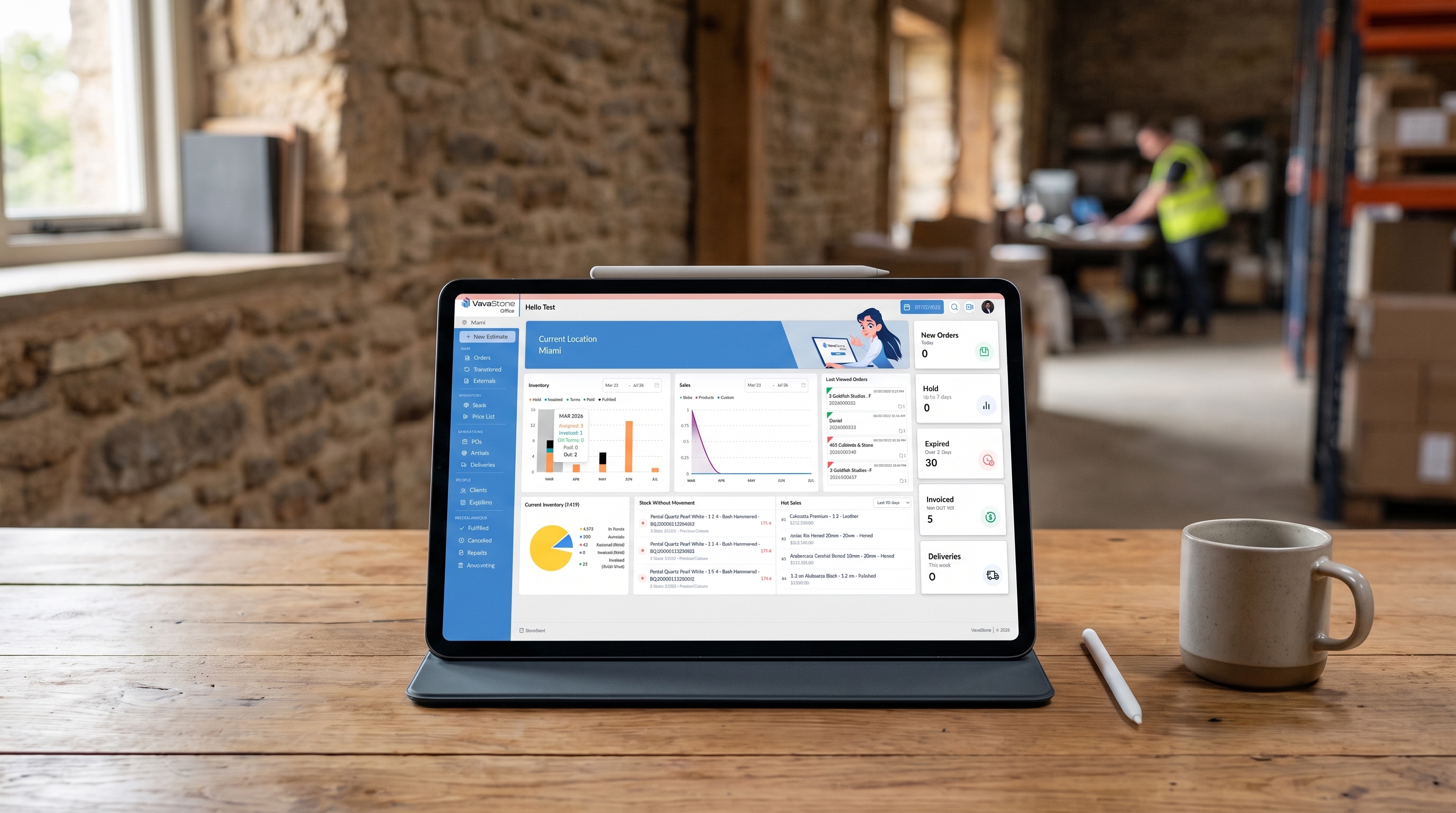
Not all stone software is the same. If you’ve started looking at inventory management software for your stone distribution business, you’ve probably noticed that the options range from generic platforms adapted for the industry to tools built specifically for stone. Choosing the right one matters — both for your operation and for your team’s adoption.
This guide covers the key dimensions to evaluate, regardless of which platform you’re considering.
1. Is it built for stone, or adapted for stone?
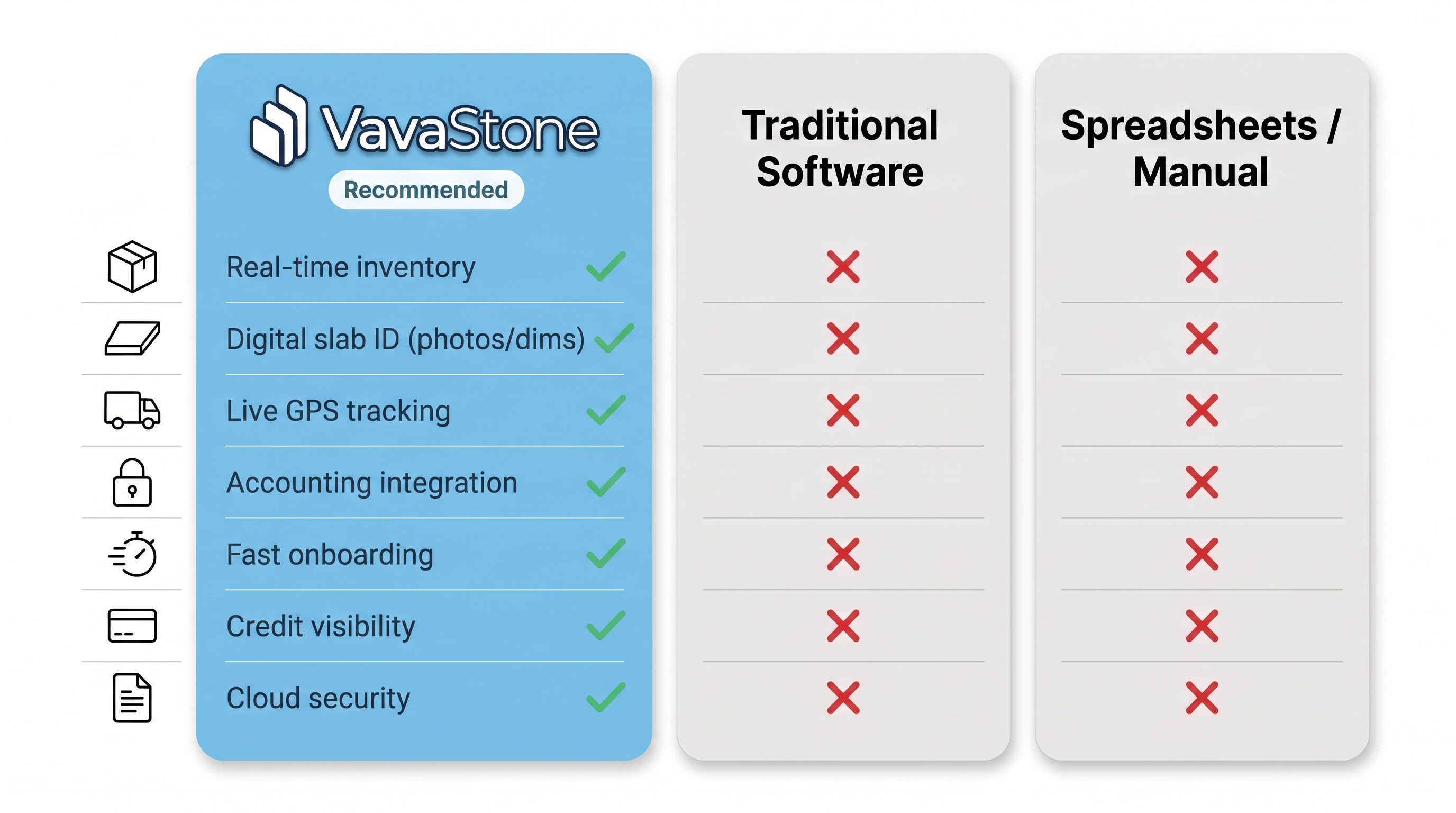
There’s a meaningful difference between software that was designed for the stone industry from the ground up and general inventory software that’s been configured to handle stone. Stone-specific platforms understand the fundamental unit of the business: the individual slab. Each slab has unique dimensions, veining, and availability status. Generic platforms treat inventory as units or quantities — they don’t naturally handle the reality that no two slabs are identical.
2. How does it handle real-time availability?
The critical question: when a slab is committed to a customer, does it immediately become unavailable to everyone else? Some systems update in real time. Others update on a delay, or require manual status changes. For a multi-person sales team, the difference between real-time and near-real-time can be the difference between zero double-sells and regular ones.
3. What does the multi-location experience look like?
If you manage more than one yard, test the multi-location experience specifically. Can your team see combined inventory across all locations from a single screen? Are location transfers tracked automatically? The answers to these questions are more telling than any feature list.
4. How does it handle consignment?
Ask any vendor you’re evaluating to walk you through consignment tracking in detail. How does the system track slabs at fabricator locations? How does it connect consignment usage to invoicing? This is an area where many platforms are weaker than their marketing suggests.
5. What accounting integrations are available?
QuickBooks is the most common, but also ask about Xero, SAP, and Dynamics if relevant to your operation. More importantly, ask how deep the integration goes — does it sync invoices? Purchase orders? Credit notes? Or just basic transaction totals?
6. How long does implementation take?
The best software in the world is useless if it takes six months to implement. Ask for realistic implementation timelines from reference customers similar to your business size and complexity. Some platforms have distributors fully operational in under two weeks. Others are multi-month projects.
7. How does the vendor respond to your specific needs?
This is perhaps the most underrated evaluation criterion. When you describe a specific operational requirement — something unique to how your business works — how does the vendor respond? Do they have a rigid answer, or do they engage with your specific situation and look for solutions?
A platform that evolves with your requirements is worth more than a feature-complete platform that can’t accommodate how you actually work.
VavaStone is built specifically for natural stone distributors.
It adapts to how you work. Book a free 20-minute demo at vavastone.com — no commitment, no pressure.
Book a Demo